


Restaurant equipment depreciation and central kitchens: daily proration and multi-store allocation
Written by the S4 Consulting Oracle NetSuite team · Reviewed by Lạc Phạm, Solution Architect, S4 Consulting · Updated 27 Oct 2026
Restaurant equipment depreciation under Vietnam’s Circular 45/2013/TT-BTC starts on the exact day equipment goes into use, prorated by the actual days of the month, so a store opening mid-month only carries depreciation for the remaining days. F&B chains with a central kitchen face a second requirement: depreciation on shared equipment must be split across departments by percentages that change each time a new store opens. S4 Consulting supports both platforms: a fixed asset package for Acumatica and S4 eSuite FAM for NetSuite for F&B chains and groups on Oracle NetSuite.
How is restaurant equipment depreciation calculated for a mid-month opening?
Multiply the full monthly charge by the days in use and divide by the days in that month. Restaurant equipment is a fixed asset when it costs at least VND 30 million and lasts more than one year, with a useful life chosen inside the Appendix I range of Circular 45.
| Equipment (illustrative example) | Cost | Life | Full monthly charge | First month |
|---|---|---|---|---|
| Espresso machine, store opens 15 Sep | VND 240,000,000 | 5 years | VND 4,000,000 | 4,000,000 x 16/30 = VND 2,133,333 |
| Central kitchen line, live 20 Jul | VND 1,800,000,000 | 10 years | VND 15,000,000 | 15,000,000 x 12/31 = VND 5,806,452 |
The useful lives above are assumptions for illustration; check the actual asset group in Appendix I. For high-output equipment that loses value quickly, Circular 45 allows adjusted declining balance with factors of 1.5 for lives up to 4 years, 2.0 for over 4 to 6 years and 2.5 for over 6 years, where the conditions are met.
Why does a 30-day convention distort depreciation?
Because Circular 45 counts the actual days of the month, while many international ERPs use period conventions. Standard NetSuite Fixed Assets Management (standard FAM) offers a Pro-rata rule based on a flat 30-day month and a Mid-month rule with a half-month cut-off. For the central kitchen above, July has 31 days, so a 30-day convention will rarely produce exactly VND 5,806,452.
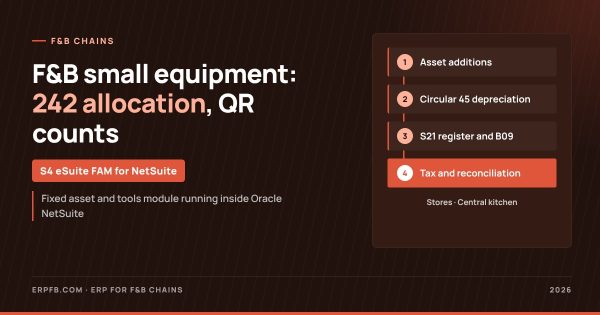
A chain opening dozens of stores a year ends up with dozens of assets out of line in their first and last months. Standard FAM does let you build custom depreciation formulas, but the adjusted declining balance factors, the Appendix I ranges and the Vietnamese registers still have to be built. S4 eSuite FAM previews Circular 45 day counts and charges for every asset before posting, with a daily depreciation schedule per month that exports to Excel. The method is explained in Circular 45 depreciation on NetSuite.
Vietnamese fixed asset accounting inside NetSuite
Circular 45 daily depreciation, tools and account 242, transfers, QR counts and the S21-DN to S23-DN registers. See the product page or download the brochure.
How is central kitchen depreciation allocated across stores?
Depreciation on shared equipment is split across the departments using it by percentages the company sets, and each change needs an effective date so that closed periods are not rewritten. Illustrative example: the central kitchen cold store carries VND 15,000,000 a month and serves the kitchen itself and the stores. From 1 October the chain opens store C and the split changes.
| Department | Expense account | To 30 Sep | From 1 Oct |
|---|---|---|---|
| Central kitchen | 627 | 50% = VND 7,500,000 | 40% = VND 6,000,000 |
| Store A | 641 | 25% = VND 3,750,000 | 20% = VND 3,000,000 |
| Store B | 641 | 25% = VND 3,750,000 | 20% = VND 3,000,000 |
| Store C | 641 | 20% = VND 3,000,000 | |
| Total | VND 15,000,000 | VND 15,000,000 |
In S4 eSuite FAM, one asset can be allocated to several departments and expense accounts such as 627, 641 and 642 by percentages with effective dates. The 06-TSCĐ depreciation schedule shows last month, additions, disposals, this month and the split by accounts 6274, 6414 and 6424, with VND rounding that matches to the dong across lines. The result feeds per-store profit and loss.
How are kitchen overhauls and upgrades accounted for?
Routine maintenance is expensed, while major repairs that upgrade the asset are collected in account 2413 and added to cost on completion, with a recalculated charge. Illustrative example: the VND 1,800,000,000 central kitchen line has run 24 full months with VND 360,000,000 accumulated depreciation. An upgrade costing VND 120,000,000 is made and the remaining life stays at 96 months. The new monthly charge is (1,440,000,000 + 120,000,000) / 96 = VND 16,250,000.
S4 eSuite FAM records the upgrade through 2413, recalculates the charge and produces the 03-TSCĐ completion record. When equipment is out of action for a long repair, depreciation can be suspended in line with the rules.
How is equipment disposed of when a store closes?
Usable equipment should be transferred to another store with a transfer slip, and equipment no longer needed is sold or scrapped with a disposal committee and a 02-TSCĐ record. Illustrative example: an espresso machine costing VND 240,000,000 with VND 120,000,000 depreciated is sold for VND 80,000,000 before VAT, assuming a 10% rate.
| Transaction | Debit | Credit | Amount |
|---|---|---|---|
| Remove accumulated depreciation | 214 | 211 | VND 120,000,000 |
| Net book value to other expenses | 811 | 211 | VND 120,000,000 |
| Disposal income | 131 | 711 | VND 80,000,000 |
| Output VAT | 131 | 3331 | VND 8,000,000 |
S4 eSuite FAM posts these entries as one-account-per-side pairs as in the table, rather than a single compound entry, and keeps the store and department dimensions so the closed store’s profit and loss stays complete. If items are missing at handover of the premises, the pending value goes to 1381.
Do warranty and maintenance reminders belong in the ERP?
Yes, because an oven, freezer or espresso machine failing at peak hour hits revenue directly, and repairs under warranty cost nothing. When warranty dates sit in paper contracts at each store, the maintenance team rarely knows an item is out of cover. S4 eSuite FAM sends insurance, warranty and inspection reminders a chosen number of days ahead from the asset card.
When is restaurant equipment depreciation non-deductible?
Under Article 10.6 of Decree 320/2025/ND-CP, depreciation is non-deductible when the asset is not used for business, lacks ownership records, is not tracked in the books, is charged above the permitted rate or is already fully depreciated. Equipment from a closed store left in storage for months is the case chains should watch. S4 eSuite FAM calculates the deductible portion at each run and keeps a book-versus-tax depreciation difference table. On Acumatica, chains running Acumatica F&B Edition can use the S4 fixed asset package for Acumatica; on NetSuite, see the S4 eSuite FAM product page or read F&B chain small equipment and account 242.
Frequently asked questions
How is depreciation calculated for a store opening mid-month?
Multiply the full monthly charge by the days in use and divide by the days in the month. Illustrative: 4,000,000 x 16/30 = VND 2,133,333.
Can central kitchen depreciation be split across stores?
Yes. One asset can be allocated to several departments and expense accounts such as 627, 641 and 642 by percentages with effective dates.
Where are kitchen upgrade costs recorded?
Major repairs that upgrade the asset are collected in account 2413, then added to cost on completion with a recalculated charge.
What entries are made when equipment is sold on store closure?
Dr 214 and Dr 811 / Cr 211 for the removal, and Dr 131 / Cr 711 and Cr 3331 for the proceeds, with a 02-TSCĐ record.
Is depreciation on stored equipment from a closed store deductible?
It may not be if the asset is not used for business under Decree 320/2025/ND-CP, so transfer or dispose of it promptly.
References
- Thu vien Phap luat - Circular 45/2013/TT-BTC on fixed asset depreciation and amendments (in Vietnamese)
- Thu vien Phap luat - Non-deductible depreciation under Decree 320/2025 (in Vietnamese)
- Oracle NetSuite Help - Asset Type General Subtab (Fixed Assets Management)
- Oracle NetSuite Help - Creating a New Depreciation Method
- Oracle NetSuite Help - Depreciating Assets for the Period