

F&B chain small equipment: account 242 allocation, store transfers and QR counts
Written by the S4 Consulting Oracle NetSuite team · Updated 27 Oct 2026
F&B chain small equipment such as tables and chairs, glassware, crockery and kitchen utensils usually costs less than VND 30 million per item, so in Vietnam it is booked to prepaid expenses in account 242 and allocated to each store over time. The difficulty is volume and movement: thousands of items spread across outlets, constant breakage and loss, and movement every time the chain opens, closes or refits a store. S4 Consulting supports both platforms: a fixed asset package for Acumatica and S4 eSuite FAM for NetSuite for F&B chains and groups running Oracle NetSuite.
What counts as F&B chain small equipment and how is it booked?
Under Circular 45, an item is a tangible fixed asset only when it costs at least VND 30 million and lasts more than one year; most store items fall below the value threshold and are tools. When issued, the value goes to account 242 and is allocated monthly, or expensed immediately if small and short-lived, depending on the company’s accounting policy.
| Item (illustrative example) | Value per item | Usual treatment |
|---|---|---|
| Dining table and chair set | VND 3,500,000 | Tool, allocated via 242 |
| Kitchen utensils: pots, pans, knives, trays | Under VND 30 million | Tool, allocated via 242 |
| Glassware and crockery | Small, frequent breakage | Short allocation or expensed |
| Blender, small counter chiller | Under VND 30 million | Tool, allocated via 242 |
| Professional espresso machine | From VND 30 million, over 1 year | Fixed asset |
When a card is created in S4 eSuite FAM with a cost below VND 30 million, the system warns that the item is a tool so the accountant can review it before recording.
When F&B chains move from MISA, FAST or Bravo to an international ERP, accountants often keep a parallel Excel file of tools per store because the standard asset module has no tool or 242 register. Each store opening or closing means manual edits, and the 242 balance in the file slowly drifts from the ledger.
How is account 242 allocated when a new store opens?
All small equipment for a new store goes to account 242 and is charged monthly to that store, over a period not exceeding 3 years to remain deductible for corporate income tax under Decree 320/2025/ND-CP. Illustrative example: a new store buys 60 table sets at VND 3,500,000 each, VND 210,000,000 in total, plus VND 90,000,000 of kitchen utensils. The VND 300,000,000 is allocated over 24 months, VND 12,500,000 a month to that store.
Allocating to the right store, rather than to head office or a chain-wide pool, is what makes per-store profit and loss trustworthy. If a new store’s equipment cost sits in head office or is spread evenly across the chain, the new store looks more profitable than it is in its first months, while older stores carry costs that are not theirs.
Vietnamese fixed asset accounting inside NetSuite
Circular 45 daily depreciation, tools and account 242, transfers, QR counts and the S21-DN to S23-DN registers. See the product page or download the brochure.
How are transfers handled when stores open, close or refit?
When equipment moves between stores, its unallocated value moves with it, and from the handover date the allocation belongs to the receiving store. Continuing the example: after 10 months the store closes with an unallocated value of 300,000,000 x 14/24 = VND 175,000,000. If the tables and utensils go to two other stores, that amount must be split by the quantities actually sent to each.
In S4 eSuite FAM, a transfer slip records the requester, approver, sender and receiver, a step-by-step log, a handover record and the condition on dispatch and receipt. It can change department, location and segment, so the receiving store sees the items in its own register straight away. Tool cards can be split by quantity, which suits one batch of tables shared across several stores. Form S22-DN under Circular 99, the register of assets and tools at the place of use, can be kept per store.
How do QR labels and phone scanning work in stores?
The practical approach is to label items that have value and individual identity, such as tables, chillers and large kitchen equipment, while glassware and crockery are tracked by batch and counted. Store staff scan labels with a phone camera, with no special hardware needed.
In S4 eSuite FAM, the process runs in four steps:
- Create a count: choose the scope by location and asset type, for example all stores in one region.
- Print labels: QR codes or barcodes on A4 sheets of 3 x 8, filtered by location so each store gets its own sheet.
- Scan: with a phone camera or a scanner, with results recorded against the count.
- Close the count: the system generates shortage, surplus and damage transactions and prints the 05-TSCĐ record.
How are shortages and breakages of F&B chain small equipment handled?
Shortages go to 1381 pending resolution at the unallocated value, surpluses are recorded against 3381, and damaged items are flagged so the chain can decide whether to repair, replace or write off. Illustrative example with the tables above after 10 months: 4 sets missing, cost 4 x 3,500,000 = VND 14,000,000, unallocated value 14,000,000 x 14/24 = VND 8,166,667, recorded as Dr 1381 / Cr 242.
| Count result | Handling in S4 eSuite FAM |
|---|---|
| Shortage | Value moved to 1381 pending resolution |
| Surplus | Draft card created against 3381 |
| Damage | Condition recorded, item suspended for follow-up |
For glassware broken daily, many chains expense it directly or use a short allocation period to avoid thousands of pending lines. That is a policy decision for the chief accountant to agree up front and document in the accounting policy, not something the software decides.
What does the 3-year cap under Decree 320 mean for F&B chains?
It means tool costs that do not meet fixed asset criteria are only deductible for corporate income tax if allocated over no more than 3 years. Chains refit stores in cycles, so allocation periods of 12 to 36 months for furniture and utensils are reasonable, with controls so that no tool card exceeds the cap. S4 eSuite FAM reconciles the asset subledger with the 242 ledger balance and flags manual entries posted outside the module.
Which S4 solution fits a chain on Acumatica or NetSuite?
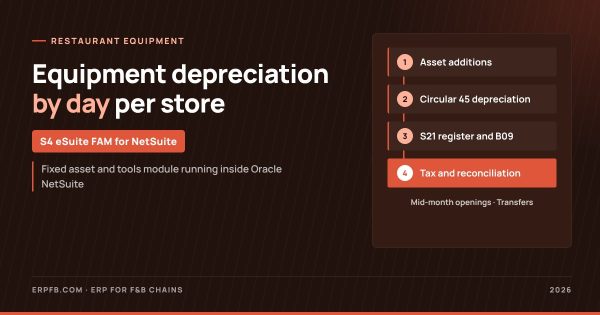
It follows the ERP the chain runs. Chains on Acumatica F&B Edition can use the S4 fixed asset package for Acumatica, alongside multi-company financials. Chains and groups on Oracle NetSuite can add the S4 eSuite FAM module for assets and tools under Vietnamese standards. For depreciation of larger equipment, read restaurant equipment depreciation, or download the S4 eSuite FAM brochure.
Frequently asked questions
Are store tables and chairs fixed assets or tools?
If each set costs less than VND 30 million, they are tools booked to account 242 and allocated to the store.
Over what period should new-store equipment be allocated?
The company sets it based on useful life, but it must not exceed 3 years to stay deductible under Decree 320/2025/ND-CP.
What happens to equipment when a store closes?
It is transferred to other stores with its unallocated value, or written off if no longer usable, based on a handover record.
Should glassware carry QR labels?
Usually not. Label items with value and individual identity, and track glassware and crockery by batch and count.
How is a shortage of small equipment recorded?
Record the unallocated value of missing items as Dr 1381 / Cr 242 pending resolution, then settle it by decision.
References
- Thu vien Phap luat - Circular 45/2013/TT-BTC on fixed asset depreciation and amendments (in Vietnamese)
- Thu vien Phap luat - Non-deductible depreciation under Decree 320/2025 (in Vietnamese)
- MISA AMIS - Fixed asset register form S21-DN under Circular 99/2025/TT-BTC (in Vietnamese)
- Oracle NetSuite Help - Asset Type General Subtab (Fixed Assets Management)