

Reconcile on data, not self-reporting
Sales come straight from each store’s POS and are matched against fee invoices, payments, delivery collections and ingredient purchases. The franchisor spots under-reported sales or off-catalog purchasing from the data instead of waiting for periodic audits.

When to reconcile right away
When royalties and marketing fees are a percentage of sales, every under-reported sale is a fee the franchisor never collects.
Low sales, high ingredients
Reported sales are low but ingredient purchases stay high.
Unusual voids and discounts
Void or discount rates well above other stores.
Off-pattern ticket size
Average ticket far from stores of similar size and area.
Falling mandatory orders
Mandatory ingredient orders drop while traffic does not.
Four reconciliations every period
Because both parties record on the same documents, most reconciliation between franchisor and franchisee happens automatically.
| Reconciliation | Compares | Purpose |
|---|---|---|
| Sales and royalties | Each store’s POS sales against fee invoices issued | Catch missing, wrong or unissued fee invoices |
| Receivables and cash | Receivables against bank receipts per partner | Control overdue and short payments |
| Collections on behalf | Delivery app collections against amounts payable to partners | Match platform data to store sales |
| Marketing fund | Fund collected against fund spent | Transparency with partners |
Delivery platform data, the loyalty system and cash-register e-invoices are independent sources to check against store-reported sales.
The system takes items sold from the POS, multiplies them by each item’s recipe to get theoretical usage, and compares it with what the store bought from the franchisor in the same period, adjusting for opening and closing stock and allowed waste.
A store’s POS records 3,000 cups sold in a month at 20 g of coffee per cup, or 60 kg of theoretical usage. If the store bought 75 kg and stock did not change, the 15 kg gap equals roughly 750 unexplained cups. If it bought only 40 kg, it may be using off-catalog ingredients.
A variance does not automatically mean fraud: waste, voids or inaccurate recipes can all explain it. But it is a signal to work with the partner on concrete figures.


Controls built into POS setup
Prevention is always cheaper than detection. Franchise store POS on S4 F&B is preconfigured to brand standards.
Locked invoice deletion
Paid invoices can only be voided with a reason and an approver.
Audit trail
Every void, discount and price change is logged.
Central promotions
Only promotions configured by the franchisor are allowed.
Locked brand standards
Menus, prices and recipes that belong to the brand cannot be edited.
Cash-register e-invoices
POS sales and issued invoices live in the same system.
Store benchmarking
Daily sales, ticket size, void and discount rates, and ingredient cost to sales.
When anomalies appear, what next?
Every step relies on data, protecting the partnership instead of acting on impressions.
Verify the data
Check recipes, stock, waste and legitimate causes.
Talk to the partner
Discuss concrete figures by period and item.
Inspect the store
Under the inspection rights in the franchise contract.
Apply the contract
Adjust fees or apply contract terms when justified.
Who this is for
- F&B brand owners growing through franchising who need network control on real data.
- Chains running company-owned and franchise stores side by side.
- Chains with a central kitchen or main warehouse supplying mandatory ingredients.
- Multi-entity groups that need VAS consolidation.
Explore further
Franchise supply
Franchisees order on S4 F&B, Acumatica creates sales orders, checks credit limits, and issues invoices and lot-tracked…
Franchise accounting
Franchise revenue accounting on Acumatica: automated royalties and marketing fees, bulk fee invoicing, pass-through…
Franchise chain solution
Two-platform architecture: Acumatica for the franchisor, S4 F&B for partners.
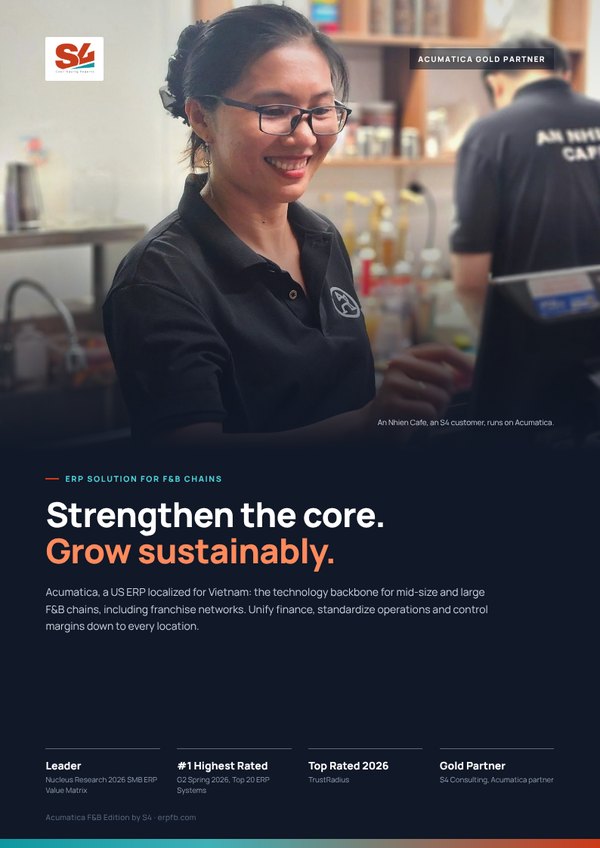
Acumatica F&B Edition by S4 brochure
Six pages for leadership: four capability layers, solutions by chain model and franchising, Vietnam compliance, the xRP platform, the An Nhien Cafe story and the Fast & Saving roadmap.
FAQ
What does franchise revenue reconciliation cover?
How can a franchisor detect under-reported sales?
Is an ingredient variance proof of fraud?
What is needed for accurate reconciliation?

 Gold Partner
Design the process for your franchise network
Talk with Lac Pham or Nu Huynh about fee models, supply flows, reconciliation and the Acumatica plus S4 F&B rollout for your chain.