

Unlimited User ERP for F&B Chains: Why Per-User Licensing Becomes a Burden
Labor-intensive groups need unlimited user ERP for F&B chains because per-user pricing makes software cost rise in step with the number of stores, shifts and staff who need system access. For a chain with VND 500-2,000 billion in revenue (about USD 19-77 million) and hundreds of stores, this can be a major difference in total cost of ownership. Acumatica prices by application and resources rather than by number of users, so store managers, shift supervisors, warehouse teams and franchise partners can all take part in the system.
The workforce profile of an F&B chain is large, fast-rotating and varied: full-time employees, shift workers, part-time staff and seasonal hires for holidays and Tet. A licensing decision that looks technical in fact shapes the level of internal control in every store. The platform choice itself is analysed in ERP for F&B chains with VND 500-2,000 billion in revenue.
Who in an F&B chain needs access to the ERP?
Not only head office, but every role that creates data in stores and kitchens. When only head office uses the ERP, store figures arrive late and pass through several intermediate layers.
- Store managers: ingredient ordering, goods receipt, stock counts and store profit and loss.
- Shift supervisors: timesheet confirmation, wastage recording, shift close and revenue reconciliation.
- Central kitchen: production orders for semi-finished goods, recipe-based portioning and transfers to stores.
- Warehouse and purchasing: supplier receipts, transfers and expiry date management.
- Area managers and franchise partners: store-level reports, approvals and franchise fee reconciliation.
- Finance and internal control: multi-entity consolidation, internal audit and margin analysis.
How does per-user cost grow as the chain expands?
Cost grows linearly with the number of accounts. The table below is an illustrative example based on the published list prices of Microsoft Dynamics 365 Business Central for subscriptions purchased from 1 October 2025 (Essentials USD 80, Premium USD 110 per user per month), assuming two users per store plus head office and central kitchen. The figures exclude discounts or specific licence configurations and are not a quotation.
| Illustrative scale | Users | Per-user USD 80/month | Per-user USD 110/month | Acumatica |
|---|---|---|---|---|
| 60 stores | 160 | USD 153,600/year | USD 211,200/year | Not priced per user |
| 150 stores | 400 | USD 384,000/year | USD 528,000/year | Not priced per user |
| 250 stores | 620 | USD 595,200/year | USD 818,400/year | Not priced per user |
For Acumatica, according to S4’s quotation benchmarks for businesses at the VND 500-2,000 billion scale, the subscription typically stays within USD 20,000-50,000 per year, or about VND 0.52-1.3 billion at a reference rate of about VND 26,000/USD, depending mainly on applications and system resources. What matters is the slope of the cost curve when the network doubles, not just the first-year figure.
Bring every store and the central kitchen onto one ERP
See how Acumatica F&B Edition by S4 lets store managers, shift supervisors, warehouses and franchise partners work on a single platform.
Explore the F&B chain ERP solution →Book an executive briefing
Why does unlimited user ERP for F&B chains strengthen internal control?
Because it removes the incentive to share accounts. When every account carries a fee, businesses tend to share logins or grant access to only a few people. Shared accounts break the audit trail: it becomes impossible to tell who received goods, who adjusted inventory or who approved wastage. Limiting users also means store data is compiled manually and re-keyed, which creates delays and errors. In a multi-brand group, this is a control gap that auditors and investors regularly question.
Unlimited user ERP for F&B chains gives every person an individual account with role-based permissions. Every action leaves a trace, and data is captured where it originates. An in-depth look at the licensing model is available in unlimited user licensing for F&B chains.
How do shift and part-time workers affect the licensing decision?
Shift and part-time workers make the number of people who interact with the system far larger than the number of regular users. They need to see rosters, confirm timesheets and receive payslips; shift supervisors need to record productivity and wastage by shift. Under a per-user model, the business must weigh every group of staff; under an unlimited user model, the decision is driven by management needs.
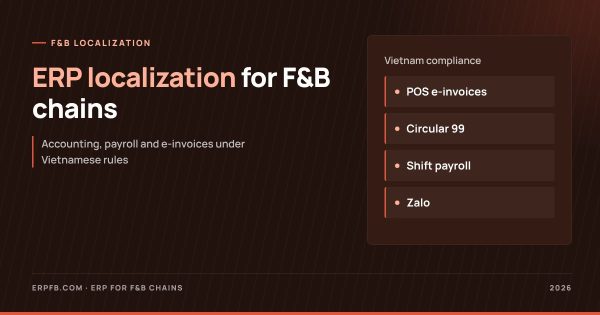
S4 has developed the VN Payroll package on Acumatica, which calculates pay by shift and overtime, social, health and unemployment insurance, and personal income tax under Labor Code 45/2019/QH14. How to organise payroll for a chain is covered in VN Payroll for F&B chains.
How do cash register e-invoices affect the ERP?
Under Decree 70/2025/ND-CP, e-invoices generated from cash registers apply to the food and beverage sector from 1 June 2025. Every counter transaction must be linked to an invoice, so POS data, invoices and accounting revenue need to match by store and by day. The ERP must integrate with the POS and the e-invoice provider, while letting store managers and accountants reconcile differences together. This is one more reason for stores to have direct ERP access.
When are Business Central and NetSuite a fit for F&B chains?
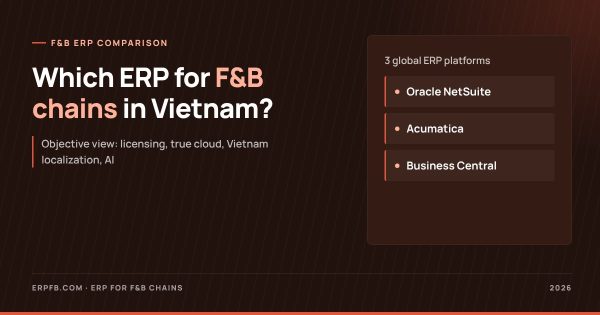
Business Central fits chains already standardised on Microsoft 365 that need deep integration with Outlook, Excel, Teams and Power BI; POS and F&B capabilities usually come from partners. Oracle NetSuite fits chains with a foreign parent company or multi-country operations that need strong multi-currency finance and consolidation. Both are priced per user, so businesses should model three- to five-year costs against their actual store opening plans. A full comparison of the three platforms is available in NetSuite vs Acumatica vs Business Central.
How should an F&B chain evaluate licensing models?
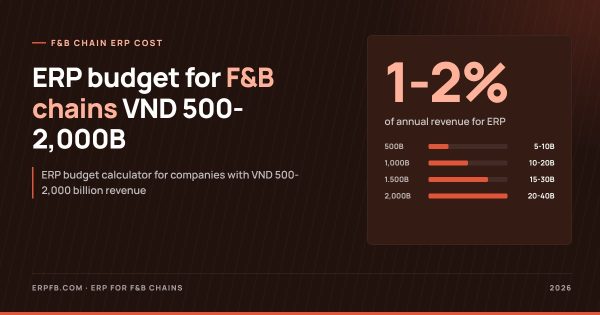
Start with a list of users by role today and in three years, based on store opening and franchise plans. Then ask each vendor to quote against the same scenario, including store and central kitchen users. Finally, compare total cost of ownership within the 1-2% of revenue ERP budget that S4 recommends. S4 Consulting - Acumatica Gold Partner in Vietnam and Oracle NetSuite consultant - can build this cost model together with the executive team.
Frequently asked questions
What is unlimited user ERP for F&B chains?
It is ERP that is not priced by number of accounts; Acumatica is priced by application and resources, so a chain can give every store access without user fees.
What is the per-user price of Business Central?
At list prices for subscriptions purchased from 1 October 2025, Essentials is USD 80 and Premium USD 110 per user per month, before discounts.
Why is sharing ERP accounts a risk?
Shared accounts break the audit trail, so it is impossible to identify who received goods, adjusted inventory or approved wastage.
When did cash register e-invoices apply to F&B?
Under Decree 70/2025/ND-CP, they apply to the food and beverage sector from 1 June 2025.
Can Acumatica handle shift and part-time payroll?
Yes, through the S4 VN Payroll package, which supports shifts, overtime, social, health and unemployment insurance and personal income tax under Vietnamese rules.