

ERP for multi-brand F&B groups
When a group runs several brands, companies and a franchise network, the question is no longer how much it sells, but how much profit each brand and each entity really generates.

Why consolidation is slow
One software per entity, one accounting approach per brand. Consolidation becomes a monthly Excel project.
Many entities
Brand company, central kitchen company and store operating companies, each with its own books.
Intercompany flows
Goods, management fees and brand fees between companies must be booked on both sides and eliminated.
Franchise network
Supplies, franchise fees and receivables need tracking per franchisee.
Group-wide standards
Each brand needs recipes, chart of accounts and reporting to one standard.
Multiple reporting standards
Foreign-invested companies report IFRS to the parent and VAS in Vietnam.
Audit and investor readiness
Investors need consistent figures traceable to source documents.


Multi-entity and consolidation: the biggest difference from fragmented software
Large F&B chains rarely have one legal entity: a brand-holding company, a central kitchen company, and companies running stores or franchises. With separate accounting software per company, every intercompany transaction is entered twice and consolidated reports are assembled in Excel. Acumatica manages an unlimited number of related companies in one system.
Central kitchen
Produces semi-finished goods and transfers them to stores owned by another company.
Intercompany transaction
The transfer creates the intercompany transaction, with due-to and due-from entries on both sides.
Store operating companies
Food cost, intercompany payables and P&L land in the right entity.
Consolidated reporting
Intercompany transactions eliminated automatically, with drill-down from group to each company.
| Process | Common approach with separate software per company | Acumatica F&B Edition by S4 |
|---|---|---|
| Legal entities | One database per company; a new company means another system | Unlimited related companies in one system, sharing chart of accounts, periods and currencies where needed |
| Intercompany transactions | Entered twice in two companies, intercompany balances matched at month-end | Due-to and due-from entries created automatically; a purchase order in one company can create a sales order in another |
| Transfers between entities | Manual issue notes, receipts and internal invoices | Transfers between warehouses of different companies generate intercompany transactions, keeping each company’s reports accurate |
| Centralized purchasing and payments | Each company buys and pays on its own | One company buys or pays on behalf of others while costs and profit stay with the originating company; shared costs allocated by rules |
| Consolidated reporting | Export each company to Excel, merge and eliminate by hand | Consolidated statements with automatic intercompany elimination and drill-down from group to company |
| Multi-currency | Manual conversion when reporting to a foreign parent | Exchange rates and automatic currency conversion with consistent reporting across entities |
| Control | Permissions per database | Permissions by company and branch; period close per company; audit trails |
Multi-entity capabilities as described by Acumatica: Acumatica Inter-Company Accounting. The “common approach” column describes the situation where each entity runs its own accounting software.
Acumatica F&B Edition by S4 capabilities for this model
Every capability below belongs to one solution and one dataset. Chains roll out in phases without stitching software together.
Financials & multi-company
Multi-company accounting, intercompany and consolidated reporting.
Store P&L & dashboards
Daily per-store P&L and dashboards for leadership.
Budgeting & cost control
Budgets by store with actual versus plan.
Vietnam compliance
Circular 99 accounting, tax, e-invoicing, IFRS alongside VAS.
One system for the organization
Unlimited users: every level of management works in one system.
Data & AI
AI Assistant and AI tool connections on ERP data, with permissions intact.
A consolidation model proven in the US
A solution for franchise networks
One solution, many chain models
Coffee & bubble tea chains
What should an ERP for coffee and bubble tea chains do?
Restaurant & QSR chains
How is a restaurant chain ERP different from restaurant management software?
Bakery chains
What capabilities does a bakery chain need in an ERP?
Diversified groups
What ERP does a diversified group need?
Franchise chains
What solution does a franchise F&B chain need?
Central kitchen & supply companies
Why should a central kitchen be managed like a separate company?
F&B companies worldwide that chose Acumatica
The results below are published by Acumatica in its customer stories. S4 Consulting was not involved in these projects; in Vietnam, S4 implemented Acumatica for An Nhien Cafe.
BLD Brands
- 8 charts of accounts managed in one system
- Month-end close reduced to 5 days
- About 90,000 invoices a year no longer keyed manually
Read the customer story ↗
A Priori Specialty Foods
- 3.5 hours a week saved by fulfillment
- 6 hours a week saved by sales
- 30% less time processing price changes
Read the customer story ↗
See it in Acumatica
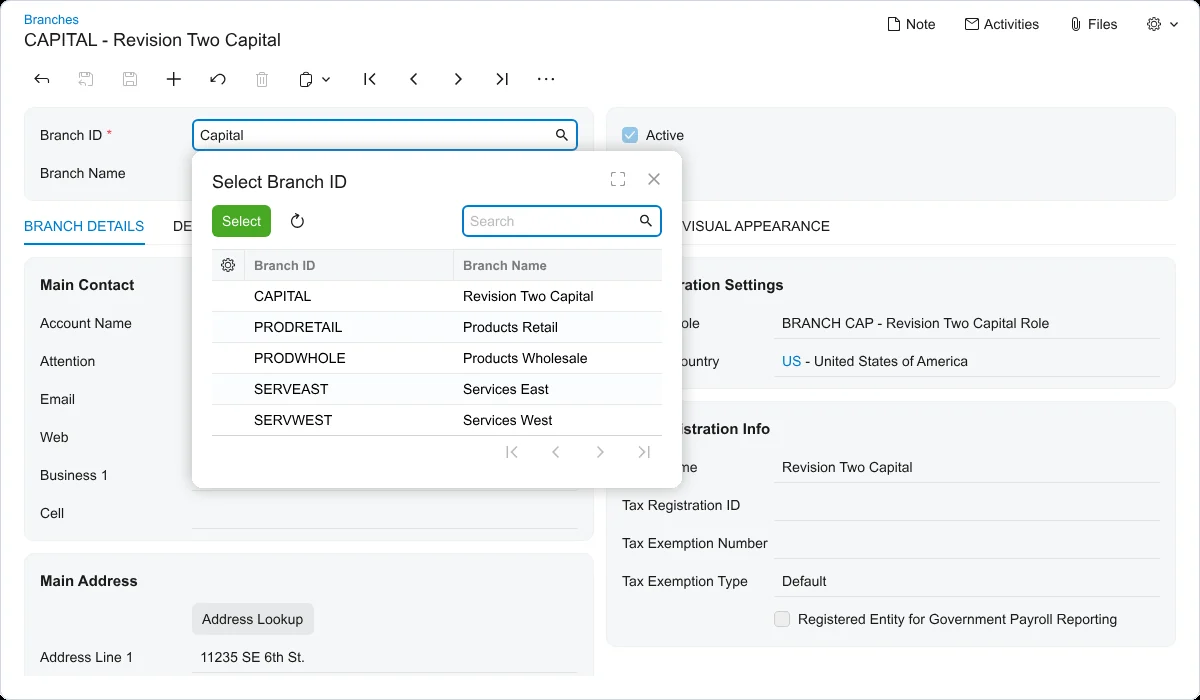
Acumatica screenshots with demo data.
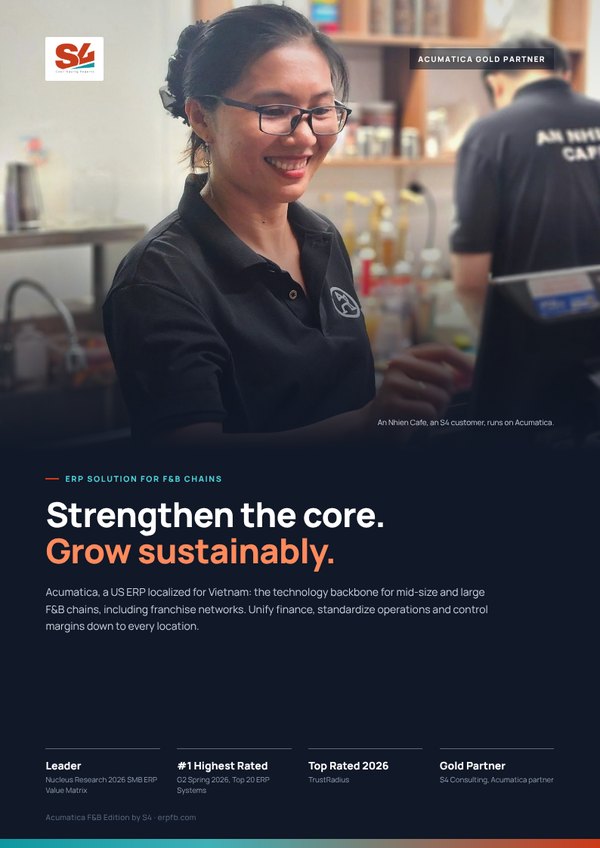
Acumatica F&B Edition by S4 brochure
Six pages for leadership: four capability layers, solutions by chain model and franchising, Vietnam compliance, the xRP platform, the An Nhien Cafe story and the Fast & Saving roadmap.
Frequently asked questions
How many entities can Acumatica manage?
Are intercompany transactions eliminated automatically?
Can we report IFRS alongside VAS?
How are franchisees managed in Acumatica?

 Gold Partner
Evaluate against your operating model
Book an Executive Briefing with Lac Pham or Nu Huynh to discuss goals, scope and the right rollout roadmap for your multi-brand groups.